Documented Assessment
We walk every slope after high wind and check the ridge, rakes and eaves along with the shingle field — that is where uplift damage shows first, not just what is visible from the ground.

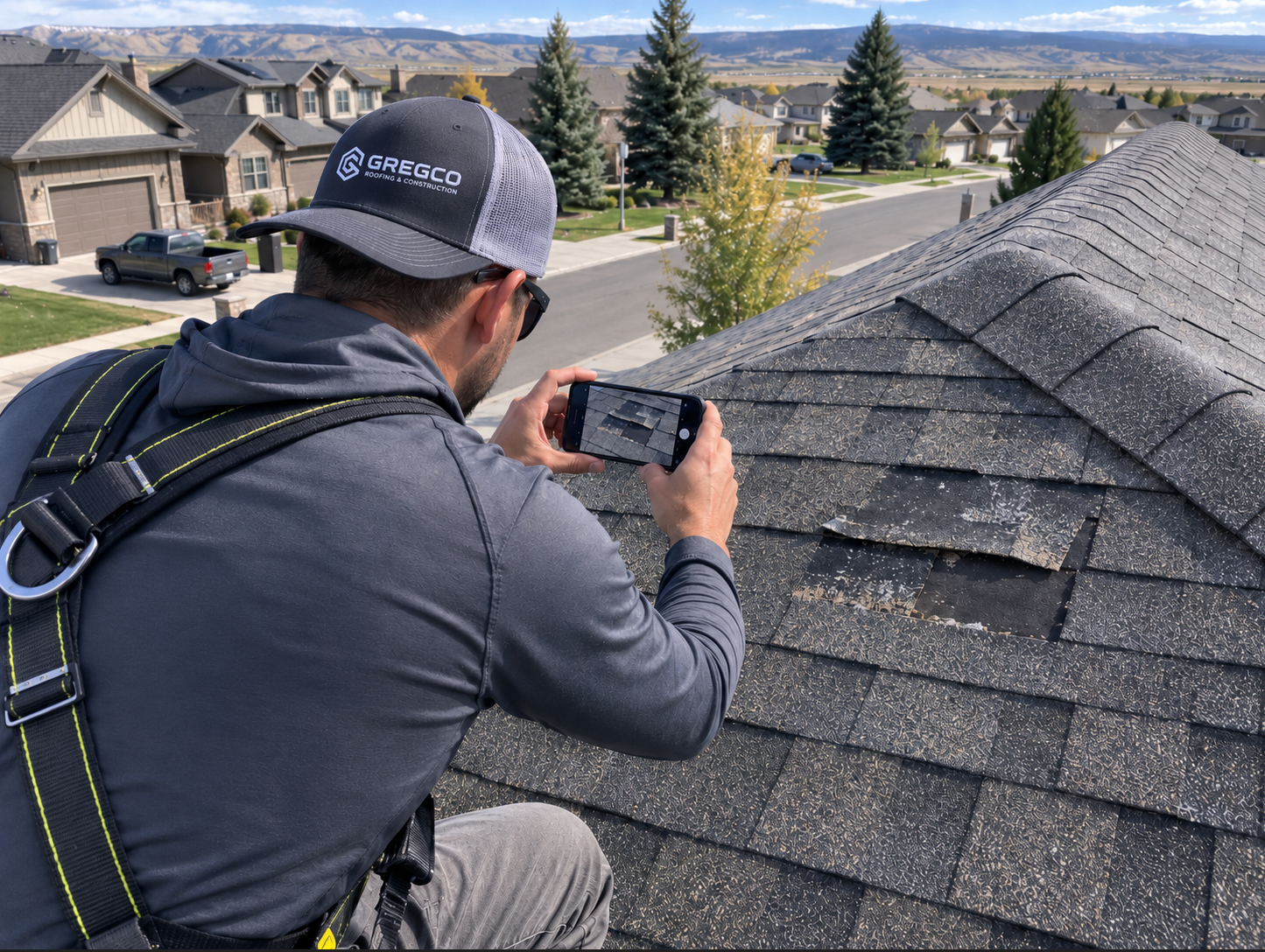
A documented wind inspection — lifted tabs, creased shingles and edge failure — with a written scope before any repair begins.
Wind damage is a shingle lifted, creased or torn loose when gusts break its factory seal. No named storm is required; routine gusts do it too. Evanston sits in the I-80 wind corridor, where winter gusts of 30 to 60 mph are common, per the Wyoming Department of Transportation and the National Weather Service.
Gregco Roofing & Construction inspects roofs after high wind, documents lifted, creased and torn shingles with photos, and puts the repair scope in writing before anyone discusses price. We document. You decide.
Wind damage rarely spreads evenly across a roof. Uplift pressure is highest at the ridge, the rakes and the eaves — the same reason an awning tears at its edge first — so those are the points we check first, and often the only ones a given storm actually reached.
Documented Assessment, Lifted & Creased Shingles, Ridge & Edge Repair, and Written Repair Scope — each explained below.
We walk every slope after high wind and check the ridge, rakes and eaves along with the shingle field — that is where uplift damage shows first, not just what is visible from the ground.
Wind breaks the factory seal that holds a shingle tab down. A lifted tab is easy to spot; a creased one can look flat and intact while that seal is already broken and due to fail in the next storm.
Uplift pressure peaks at the ridge, the rakes and the eaves, so wind damage concentrates there first. We check and repair those edges before moving to the rest of the field.
Every lifted tab, crease and torn edge we find goes into a written scope — what it is, where it is, and what we recommend — before anyone discusses price.
Four steps, always in the same order: on-site inspection, photo documentation, written wind-damage scope, we do the work.
Wyoming property owners ask 10 questions most often about wind damage repair — answered here in plain language.
There is no single number. The National Weather Service classifies sustained wind of 40 mph or gusts of 58 mph as severe enough for a High Wind Warning, but that is a warning threshold, not a damage one. A shingle's factory seal can break at gusts well below it, especially on an older roof or a course that was never sealed down properly. Evanston sits in the I-80 wind corridor, where winter gusts of 30 to 60 mph are common, per the Wyoming Department of Transportation and the National Weather Service — routine wind here does real work over a roof's life, not just the rare warning-level event.
Wind damage on shingles is lifted tabs, a crease where a shingle folded back and reset without breaking off, tabs torn loose entirely, and exposed nail heads where the tab that covered them is gone. It tends to run in one direction along a slope rather than scatter, and it shows first at the ridge, the rakes and the eaves before it reaches the open field. Hail damage scatters at random instead — see the hail damage repair page.
Yes, and it is the one wind sign most homeowners miss. Every shingle tab is held down by a factory sealant strip fused to the tab below it, and wind uplift can break that seal without tearing the shingle or lifting it for good — the tab settles back down and looks normal from the ground, even from a ladder. But the seal is gone. That shingle is loose now, free to lift again in the next gust, and it will not reseal itself. Left alone, it works looser with every windy day until it tears off or lets water track in at the exposed edge. A crease is the visible clue that the seal already failed, which is exactly why a roof check after a windstorm looks for creased tabs specifically, not just the missing shingles you can already see from the driveway.
Wind rarely hits a roof evenly. One slope usually faces the prevailing gust directly while the others sit in its lee, and a chimney, dormer or roof-to-wall transition can funnel wind into a tighter, faster stream right at that spot, the way a canyon speeds up a breeze. The section that takes the direct hit, plus the turbulence around an obstruction, is the section that loses shingles first, while the rest of the roof, outside that path, can come through the same storm with its tabs still sealed down.
Once it is safe, walk the property and look up, not just at the yard. Scan each roof slope for a shingle that looks out of line, a lighter patch where the mat shows through, or a tab curling instead of lying flat. Check the yard, gutters and downspouts for anything that blew off the roof, and look in the attic for new daylight through the decking or a damp spot on the underside. None of that tells you the full extent, but it tells you whether an inspection is worth requesting before the next storm finds the same weak spot.
It depends on what is underneath it. A missing shingle over intact underlayment needs attention soon, but it is not the same as an active leak inside the house. What actually decides the urgency is the condition of the deck and underlayment at that spot, and that is exactly what an inspection checks before anyone puts a timeline on the repair.
Usually, yes. A lifted or creased tab has already lost its seal, and every gust after that works the same weak point instead of a new one, so the damage tends to grow along that same line rather than start fresh somewhere else. A small repair today is often what keeps a loose shingle from becoming a full section that needs replacing after another windy season works on the same failed seal.
Often, yes, if the shingle itself is not torn or missing. A lifted tab that is still intact can sometimes be resealed with roofing cement and pressed back down, restoring the seal without replacing the shingle. A torn tab, a shingle that cracked when it lifted, or one that is simply gone cannot be resealed — that section gets replaced instead. The inspection tells us which repair the roof actually needs before we recommend either one.
Aerodynamics, not bad luck. Wind flowing over a roof separates and speeds up at the ridge, the rakes and the eaves, the same way air accelerates around the corner of a building, and that faster air creates suction, or uplift, that is highest right at those edges. The field of the roof, sheltered by the edge around it, feels far less of that pull. Fastening standards call for a tighter pattern at the perimeter than in the field for exactly this reason, which is also why an edge that was under-fastened at install is the first place a storm finds it.
Often, yes, on wind alone. A standing-seam panel has no tabs to lift, crease or tear, and its fasteners are either hidden under the seam or run on a set pattern that does not depend on an adhesive strip the way a shingle sealant does. That does not make metal immune — a panel can still peel back at an edge or a poorly detailed transition in a bad enough storm — but the specific failure this page covers, a lifted or creased tab, does not apply to it. See panel types and installation detail.
WYOMING SERVICE AREA
Wind Damage Repair is available across Evanston, Kemmerer, Cokeville, Rock Springs, Green River, Mountain View, Lyman — every listed city links to its own page.
Loading interactive map…
Red pins identify communities where Gregco currently accepts service inquiries. The map is for orientation, not a surveyed service boundary.
Request a wind damage repair estimate
Share the address, what you noticed, and when the issue began. Gregco will confirm the service area and contact you about the next step.