What We Document
Every condition tied to storm or hail — bruised shingles, dented soft metals, torn or lifted tabs — gets photographed where it is and dated, then organized into a written scope by area of the roof.

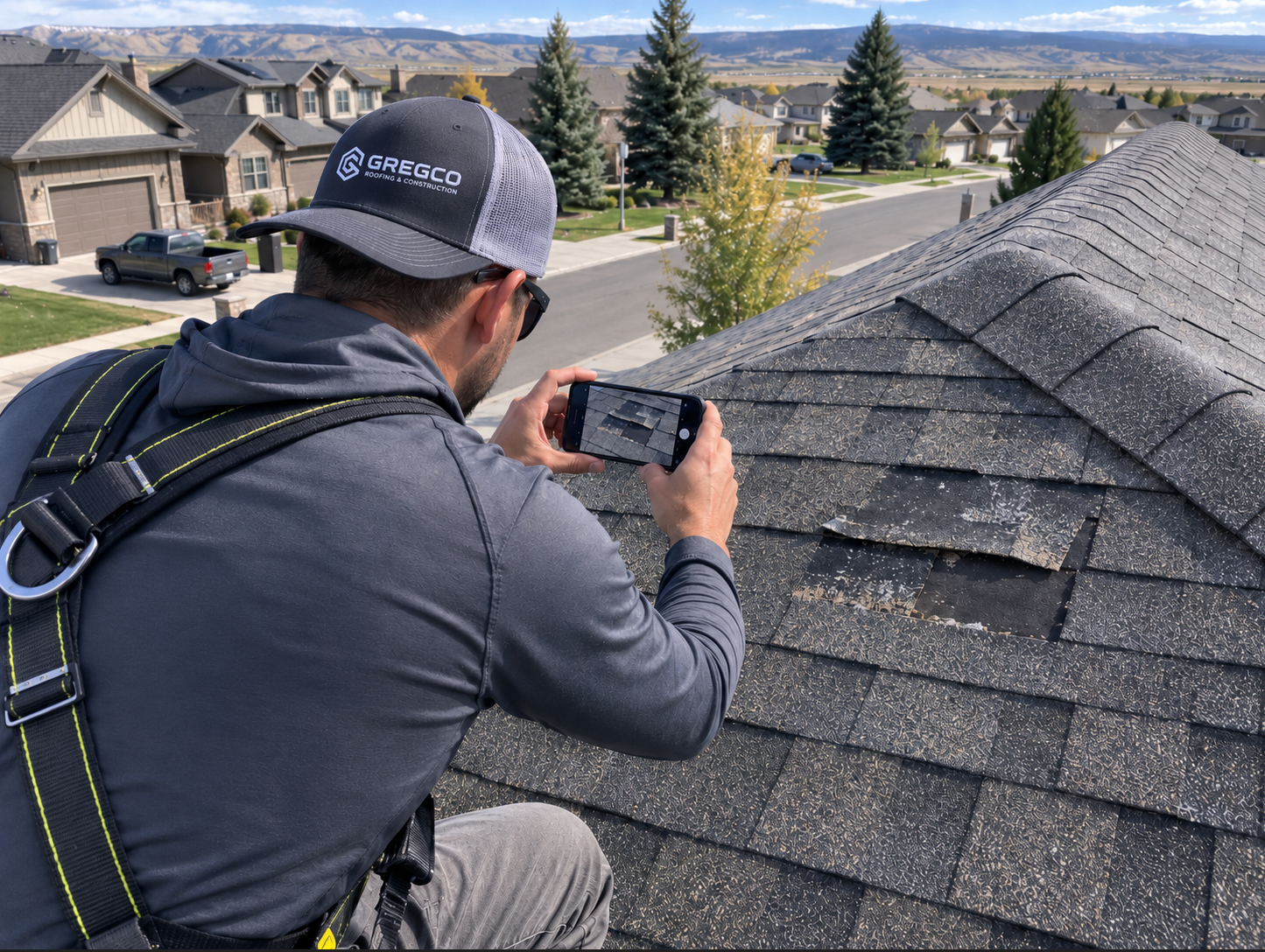
A photographed record of storm or hail damage and a written scope — the insurance company decides what it covers.
A roof insurance claim is a homeowner's request for an insurer to pay for storm or hail damage to a roof. Coverage and payment are decided by the insurance company, not the roofer documenting the damage. Severe hail of 0.75 inch or larger strikes Wyoming about 29 times a year, per the Wyoming State Climate Office.
Gregco Roofing & Construction inspects the roof, photographs the conditions found, and puts a written scope in the owner's hands before price or insurance ever comes up. We document. You decide.
Gregco recommends repair or replacement based on what the roof shows and completes the work once it is authorized — it does not negotiate a settlement, advise on whether a loss is worth reporting, or promise a covered amount.
What We Document, ACV vs RCV Explained, What Commonly Hurts a Claim, How the Scope Is Written, Assessed Against the Standards, Not an Opinion, When the Insurance Company Inspects, and Corresponding With the Carrier — each explained below.
Every condition tied to storm or hail — bruised shingles, dented soft metals, torn or lifted tabs — gets photographed where it is and dated, then organized into a written scope by area of the roof.
Actual cash value pays what the roof is worth today, after depreciation for its age. Replacement cost value pays what a new roof costs to install, often released in two payments once the work is finished. Which one applies is set by the policy, not by us.
Waiting long enough that conditions change, starting repairs before anything is photographed, and relying on a verbal opinion instead of a written, dated record are the three mistakes that come up again and again.
Estimates are produced in the same estimating platform the insurance industry uses, so the scope arrives in a format the carrier already works in. The team also carries current subscriptions to professional estimating and building-science training.
An educated, expert contractor assesses the roof against the building codes that apply and the manufacturer installation instructions for the system that is on it. That is what turns a photograph into a finding: not that something looks wrong, but which requirement it fails and why.
When the insurance company inspects the roof, Gregco can be on it at the same time — walking the same slopes and photographing what is there, so you are not deciding from a report about a surface you cannot see. Those photographs go into the same documented record every job gets. What is storm damage and what is not is the insurance company’s determination, and coverage and payment are theirs alone.
With the property owner’s written authorisation, Gregco can correspond with the insurance company directly about the documented conditions. What that correspondence covers is technical: the building code that applies in this jurisdiction, the manufacturer’s installation instructions for the roofing system on the building, and the photographs and measurements already on file.
Four steps, always in the same order: on-site inspection, photo documentation, written scope, work, if authorized.
Wyoming property owners ask 10 questions most often about storm damage documentation — answered here in plain language.
Actual cash value (ACV) pays what the damaged roof is worth today — the replacement cost minus depreciation for its age and wear. Replacement cost value (RCV) pays what a new roof of the same kind actually costs to install, with no deduction for age. Most RCV policies pay in two parts: an initial payment based on ACV, then a second payment — the withheld depreciation — once the work is finished and proof of completion is submitted. Which coverage a policy carries is set by the policy itself, not by the roof or the contractor who inspected it.
No. Gregco documents the conditions found on the roof and puts them in a written scope with a recommendation — repair, replacement, or nothing at all if that is what the roof shows. Whether the damage is covered, and how much gets paid, is decided by the insurance company alone; that determination never comes from the contractor who inspected the roof.
A dated set of photographs showing the conditions found, organized by area of the roof, along with a written scope describing what was found, where it is, and the repair or replacement recommended. That record belongs to the owner, to use however they choose — with an insurance company, with a second contractor, or with no one at all.
Waiting long enough after a storm that conditions change, or when the damage happened becomes hard to establish, is one. Starting repairs — even temporary ones — before anything is photographed is another, because it can remove the evidence a written record depends on. A third is relying on a verbal opinion instead of a dated, photographed scope that another contractor or the insurance company can actually review.
No. An offer to pay, waive, or discount a customer's deductible is insurance fraud, not a discount, no matter how it is worded or who is making it. These offers tend to come from a door-knocking crew right after a storm, timed to catch a homeowner before they get a second opinion. Treat any version of it as a reason to walk away, and verify a business license and a physical address before signing anything with anyone.
There is no single deadline that applies to every policy — reporting windows are set in each policy's own terms, and only the insurance company can say what a specific policy requires. What holds true regardless of the exact window: damage does not improve by waiting, granule loss keeps exposing the mat to weather, and a longer gap between the storm and the documentation leaves more room to question when the damage actually happened.
That is a decision the insurance company makes under its own underwriting rules, not something a contractor determines or predicts. Gregco documents the roof's condition and provides a written scope regardless of insurance; whether reporting affects a specific premium, and by how much, is between the owner and their insurance company.
A supplement is an addition to an insurance estimate for damage or cost that was not part of the original scope — often decking or structural damage that only becomes visible once the old roofing is removed. When that happens during a project, Gregco photographs the added condition and puts it in the written scope, the same as everything else found on the roof. Whether that addition becomes part of a payout is between the owner and their insurance company.
Payment terms for a specific project are set out in the signed contract, not this page. What holds true regardless of insurance: documenting the roof and writing the scope come first, and Gregco does not wait on an insurance company's decision to tell an owner what the roof needs. Ask about the payment schedule before signing anything; it will be in writing.
A coverage denial is an insurance decision, not a finding about whether the roof needs work — those are two different questions. Gregco recommends repair or replacement based on what the roof actually shows, independent of what an insurance company decides to pay. If coverage is denied, or an owner decides not to pursue it at all, the same recommended repair or replacement can proceed as a standard paid project on the scope already in writing.
WYOMING SERVICE AREA
Storm Damage Documentation is available across Evanston, Kemmerer, Cokeville, Rock Springs, Green River, Mountain View, Lyman — every listed city links to its own page.
Loading interactive map…
Red pins identify communities where Gregco currently accepts service inquiries. The map is for orientation, not a surveyed service boundary.
Request a storm damage documentation estimate
Share the address, what you noticed, and when the issue began. Gregco will confirm the service area and contact you about the next step.