Seamless Aluminum
Cut to length on site. Fewer seams means fewer leaks and a cleaner line along the roof edge.

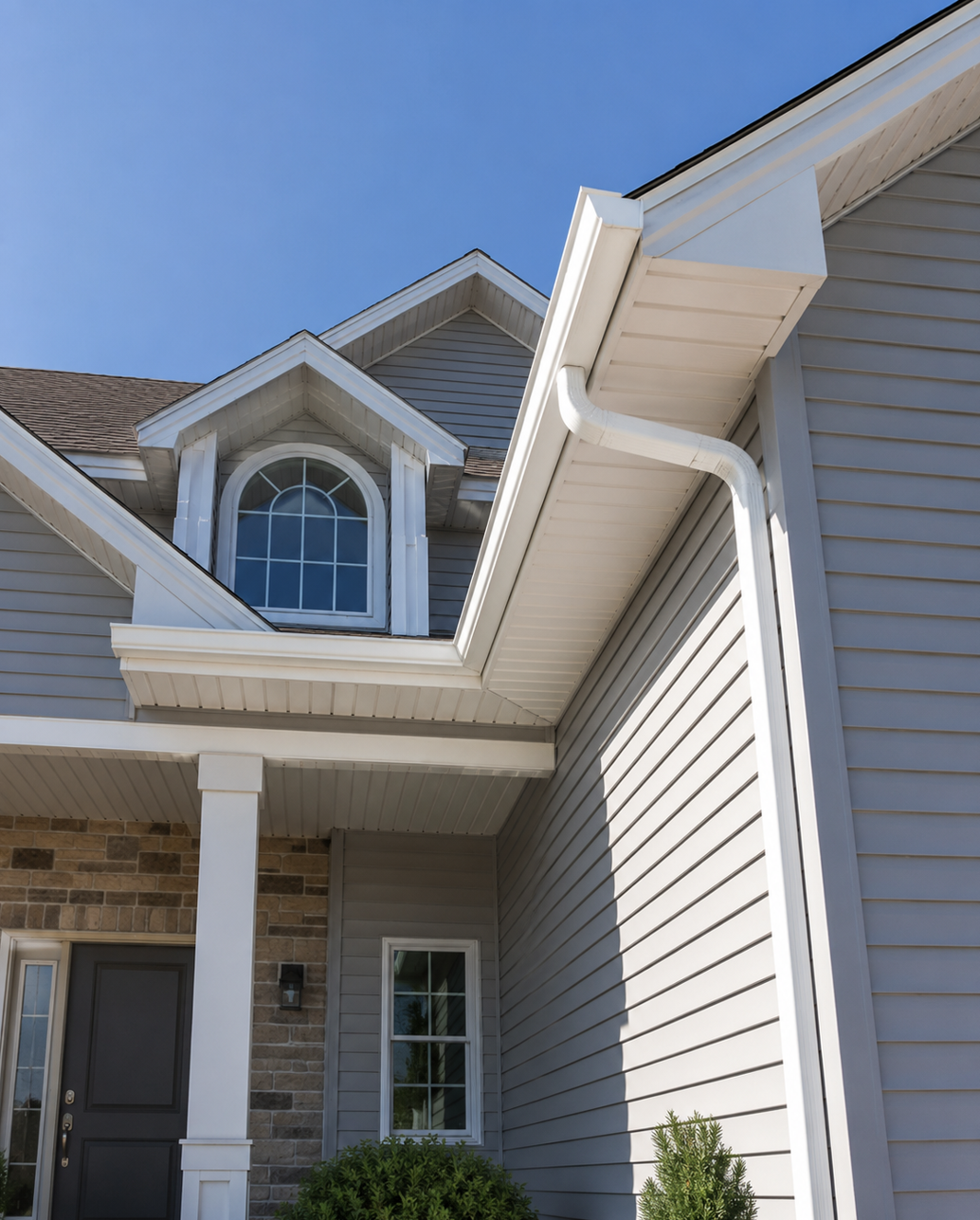
Seamless gutters that move snowmelt and storm runoff off your roof and away from the foundation.
In Wyoming, gutters do more than carry rain. They move snowmelt off the roof before it refreezes into ice dams that pry up shingles and back water under the edge. Evanston averages about 63 inches of snow a year, per US Climate Data.
Gregco Roofing & Construction installs seamless gutters across the Evanston corridor, cut to length on site, so there are fewer seams to leak. We take a look and show you what we find.
Clogged or sagging gutters dump water right at the foundation. We size and pitch every run so the water goes where it should.
Seamless Aluminum, Downspouts & Drainage, Gutter Guards, and Repair & Re-pitch — each explained below.
Cut to length on site. Fewer seams means fewer leaks and a cleaner line along the roof edge.
We route downspouts to carry water well away from the foundation, not next to it.
Optional guards keep leaves and needles out, so the gutter keeps moving water through fall and spring melt.
Sagging or overflowing? We re-secure, re-pitch, and seal runs so they drain the way they should.
Four steps, always in the same order: on-site visit, we show you the problem, we do the work, we clean up.
Wyoming property owners ask 12 questions most often about gutter installation — answered here in plain language.
A sectional gutter carries a joint every ten feet or so, and each joint is sealed rather than solid, so the sealant is what gives out first. A seamless run is rolled to length on site, which leaves a whole side of the house with no joint except at the corners and the outlet. Where ice sits in a gutter for months at a time, that is what decides how long the run lasts.
Not the way people expect. An ice dam forms because heat escaping through the ceiling melts snow that then refreezes at the cold eave, and that happens whether or not a gutter hangs under it. What a gutter does is carry the water away once it is off the roof, which protects the foundation and the siding rather than the eave. The dam itself gets addressed at the eave detail and at whatever is letting warm air reach the underside of the roof, not in the gutter.
K-style aluminum is the standard residential profile. It is flat at the back, so it sits tight against the fascia, and shaped at the front. We cut it seamless on site, one continuous run per side, and set the downspouts where the water has to leave.
A downspout extension is the piece that carries water past the ground right beside the foundation. That is where it should end. The International Residential Code calls for the ground next to a house to fall at least 6 inches over the first 10 feet, so we run the water past that.
No. Ice dams form when heat escaping through the ceiling melts snow that refreezes at the cold eave. That happens with or without a gutter under it. Evanston averages about 63 inches of snow a year, per US Climate Data, and that meltwater still has to leave the roof.
Overflow in light rain is a flow problem, not a volume problem. A blocked outlet, a run that has lost its pitch, or hangers pulling away from the fascia all push water over the front lip. We photograph where the water leaves so you can see which one it is.
Pitch is the slight fall built into a run so water travels to the outlet instead of standing. Done right, you cannot see it from the ground. Water sitting in the trough after a storm, or a dark stain down the front face, means the pitch is gone.
Both happen. A sound run that sags can be re-secured, re-pitched and resealed at the seams. Aluminum that is split, crushed by sliding snow, or hanging on rotted fascia is past repair. Photographs of the actual run decide it, not a look from the ground.
The eave detail is the few inches where drip edge, Ice & Water Shield and the gutter's back flange all meet. Because they overlap, replacing both together makes sense once the gutters are near the end of their life. The water path off the roof gets built once.
Metal sheds snow in slabs, and a slab carries weight and speed. It can bend the front lip or tear hangers out of the fascia. Kemmerer averages about 47 inches of snow a year, per US Climate Data, so we set hangers closer together under a metal eave.
Usually not across the field of the roof. A low-slope TPO or EPDM roof drains through internal drains or through scuppers cut at the parapet. Gutters belong on the sloped sections, like shop eaves, canopies and entry roofs, where the water runs to an open edge.
Long eave runs and wind. Winter gusts of 30 to 60 mph are common along the I-80 corridor, per the Wyoming Department of Transportation and the National Weather Service. A long run gives that wind something to work on, so we check the fascia before anything gets rehung.
WYOMING SERVICE AREA
Gutter Installation is available across Evanston, Kemmerer, Cokeville, Rock Springs, Green River, Mountain View, Lyman — every listed city links to its own page.
Loading interactive map…
Red pins identify communities where Gregco currently accepts service inquiries. The map is for orientation, not a surveyed service boundary.
Request a gutter installation estimate
Share the address, what you noticed, and when the issue began. Gregco will confirm the service area and contact you about the next step.