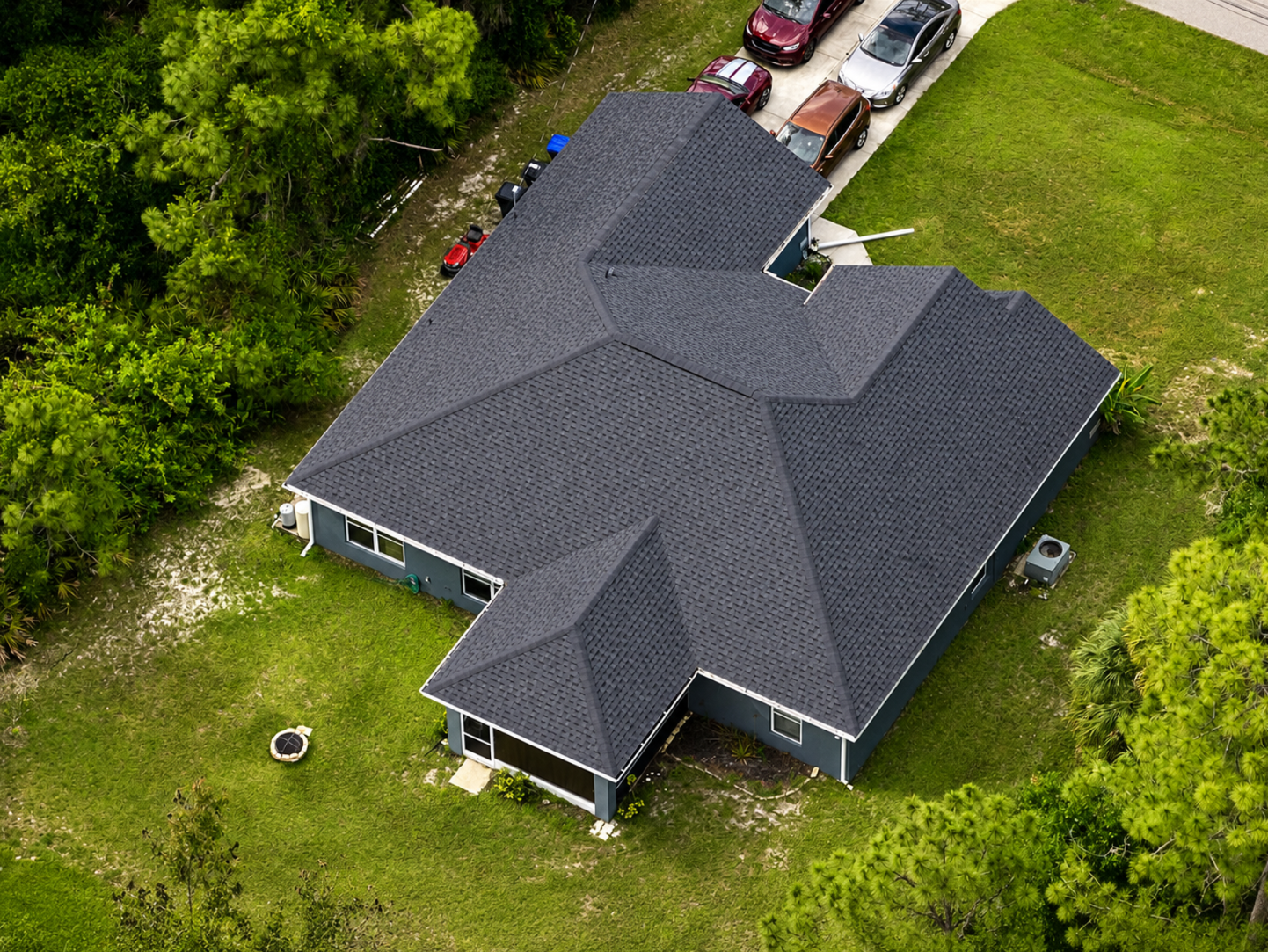
Asphalt shingle roofing is a layered mat of fiberglass, asphalt and mineral granules, made as a flat 3-tab or a thicker architectural profile. The granule layer is what actually shields the mat below it from ultraviolet light. Evanston sits at 6,749 feet, per the US Census Bureau, where that layer takes more UV exposure than it would at sea level.
Gregco Roofing & Construction has installed asphalt shingle roofing across the Evanston corridor since 2011. We inspect the roof, photograph what we find, and put shingle profile, wind class and the scope in writing before anyone discusses price. We document. You decide.
A shingle roof does not fail all at once. The mat weakens gradually as granules wear off and ultraviolet light reaches what is left underneath, first on the slopes carrying the most sun and only later everywhere else. Reading that wear correctly, granule loss, brittleness, cupped edges, is what actually tells a homeowner whether a shingle roof is still doing its job or only looks like it.
What the shingle itself covers
What shingle roofing covers in Wyoming
3-tab and architectural shingles, explained by the material — not the tear-off project.
Architectural & 3-Tab Shingles
Three-tab is a single, flat layer with uniform cutouts. Architectural, sometimes sold as laminate or dimensional shingles, fuses two or more layers into one thicker tab, which is what gives it a raised, uneven shadow line instead of a printed pattern. That extra layer is structural, not just visual, and it is a large part of why architectural product generally outperforms 3-tab on wind and impact testing.
Wind & Impact Ratings
Every shingle line carries its own wind rating, tested and published by the manufacturer rather than assigned by the installer. An impact rating measures something different: how the mat holds up under a standardized impact test, not whether the surface can dent. Ask what a specific product is rated for before it goes on the roof, not just its color or profile.
Granule Loss & Ageing
Granules are the mineral coating on the shingle surface, and they are what actually shield the asphalt mat underneath from ultraviolet light. A little loss in the gutter runoff after a new roof settles in is normal. Bare mat showing across a slope is not — that is the shield gone, and the aging underneath speeds up once it is exposed.
Repair or Full Replacement
A handful of missing or cracked shingles on an otherwise sound field is usually a repair. Granule loss spread across most slopes, or a mat that has gone brittle instead of pliable, is the material itself signaling it is past patching. We open the area and look before recommending either one.
What to expect
How it works
Four steps, always in the same order: on-site material inspection, photo documentation, written shingle scope, we do the work.
1
On-site material inspection. We look at the shingle field itself — profile, granule condition and where wear shows first — not just the roof's age on paper.
2
Photo documentation. Every slope gets photographed close enough to show granule condition and tab seal, not a wide shot from the ground.
3
Written shingle scope. Profile, wind class and what the material actually needs, repair or replacement, goes in writing before price is discussed.
4
We do the work. Installation or repair follows the scope you signed off on, and the crew clears the site at the end of each day.
Shingle roofing, answered plainly
Common questions
Ten questions about wind ratings, granule loss, and what actually sits under the shingle.
What is the difference between 3-tab and architectural shingles?
3-tab is a single, flat layer of shingle with uniform cutouts — a lighter, lower-cost option. Architectural, sometimes sold as laminate or dimensional shingles, fuses two or more layers into one thicker tab, which is what gives it a raised, uneven shadow line rather than a printed pattern. That extra layer is structural, not just visual, and it is a large part of why architectural product generally outperforms 3-tab on wind and impact testing, not the look alone.
How long does an asphalt shingle roof last at this elevation?
There is no fixed number we can give you, and one that ignores your specific roof would not be an honest answer. What actually decides it is how far the granule layer has worn through and how well the mat has held up under repeated freeze-thaw, and both vary by product line, installation quality and how much sun a given slope gets. We check granule condition and mat flexibility directly during an inspection rather than counting years on a calendar.
What is granule loss and when does it matter?
Granule loss is the mineral coating on top of a shingle wearing thin or knocking loose, which exposes the black asphalt mat underneath. A little loss collecting in the gutter runoff after a new roof settles in is normal. It starts to matter once bare mat is visible across a slope rather than in isolated spots — that is the shield gone, and the shingle ages faster underneath once ultraviolet light reaches it directly.
What wind rating do shingles need in Wyoming?
Every shingle line carries its own wind rating, tested and published by the manufacturer — that number is not one this company assigns. Winter gusts of 30 to 60 mph are common along this stretch of I-80, per the Wyoming Department of Transportation and the National Weather Service, which is a reason to ask about a specific product's rated wind class before it goes on a roof, not a reason to assume one fixed rating applies everywhere.
Can shingles be installed in cold weather?
Yes, with the method adjusted for the temperature. The sealant strip that fuses each tab to the one below it needs warmth to activate, so shingles installed in genuinely cold weather may not seal down right away and get hand-sealed instead. The asphalt itself also stiffens as the temperature drops and can crack if bent too sharply, so installers move more carefully and more slowly once winter sets in.
What does an impact-resistant shingle actually resist?
An impact-resistant shingle is built and tested against a standardized impact rating, typically a lab test that drops a steel ball onto the shingle, not an actual hailstorm. What that rating measures is whether the mat holds together and resists puncture at the tested level — it does not mean the surface cannot dent or that a large enough hailstone cannot still bruise it. Ask what standard a specific product was tested against, not just whether the label says impact-resistant. See how hail impact is documented on a roof.
Why do shingles curl or cup?
Cupping is the edges of a shingle turning up while the center stays flat, and it usually means the shingle is drying out and losing flexibility faster than it should — from trapped heat under the shingle, from age, or from a mat that already had thin granule coverage and was taking more ultraviolet light than it could handle. A cupped shingle has lost its ability to lie flat and seal against the one next to it, which is often the point a repair stops being enough.
Can I replace just the damaged shingles?
Often, yes, if the damage is contained and the surrounding shingles are still flexible enough to lift without cracking. Matching an exact shingle gets harder the older the roof is, since colors and profiles get discontinued and the existing field has faded in the sun — we tell you before work starts if a close match is not realistic. Granule loss spread across most of the roof, or a mat that has gone brittle everywhere rather than in one spot, is a different situation than a contained patch. See the full repair-or-replace decision guide.
Do darker shingles wear faster at altitude?
Not meaningfully from color alone. A darker shingle absorbs more heat and runs hotter on a sunny roof, but the granule coating protecting the mat underneath is what actually governs how fast ultraviolet light breaks the shingle down, not the pigment on top of it. Attic heat buildup and how well a roof is vented do more to speed up wear than shingle color does, at any elevation.
What goes under the shingles, and does it matter?
Yes, more than most people assume. Underlayment is the water-resistant layer between the shingle and the deck, and Ice & Water Shield at the eaves is what actually stops meltwater that backs up under a shingle course before it reaches the deck. A shingle roof is only as good as what sits underneath it — the shingle sheds the obvious rain, and the layers below it catch what gets past that first line.
WYOMING SERVICE AREA
Shingle Roofing across Wyoming
Shingle Roofing is available across Evanston, Kemmerer, Cokeville, Rock Springs, Green River, Mountain View, Lyman — every listed city links to its own page.